Working Capital Management: A Practical Guide for Scaleups and PE-Backed Groups
Profit is an opinion. Cash is a fact. A business can report strong margins and still run out of money, and the mechanism by which that happens, in almost every case, is working capital.
Working capital is the gap between what a business is owed and what it owes: receivables on one side, payables and short-term obligations on the other. Managed well, it is the engine that keeps the business liquid and growing. Managed poorly, it is the quiet drain that turns a profitable company into one that is constantly firefighting its cash position.
For European scaleups and PE-backed groups, working capital management is not a back-office function. It is a core operational discipline, and in most growing businesses, it is the area where the most significant cash improvements are available without changing the P&L at all.
What Is Working Capital?
Working capital is defined as current assets minus current liabilities. In practice, for most operating businesses, it comes down to three components.
The relationship between these three determines your cash conversion cycle — the number of days it takes to turn a unit of input into cash in the bank.
The Cash Conversion Cycle
The cash conversion cycle (CCC) is the single most useful working capital metric for an operating business. It tells you how long cash is tied up in the operating cycle before it comes back as a receipt.
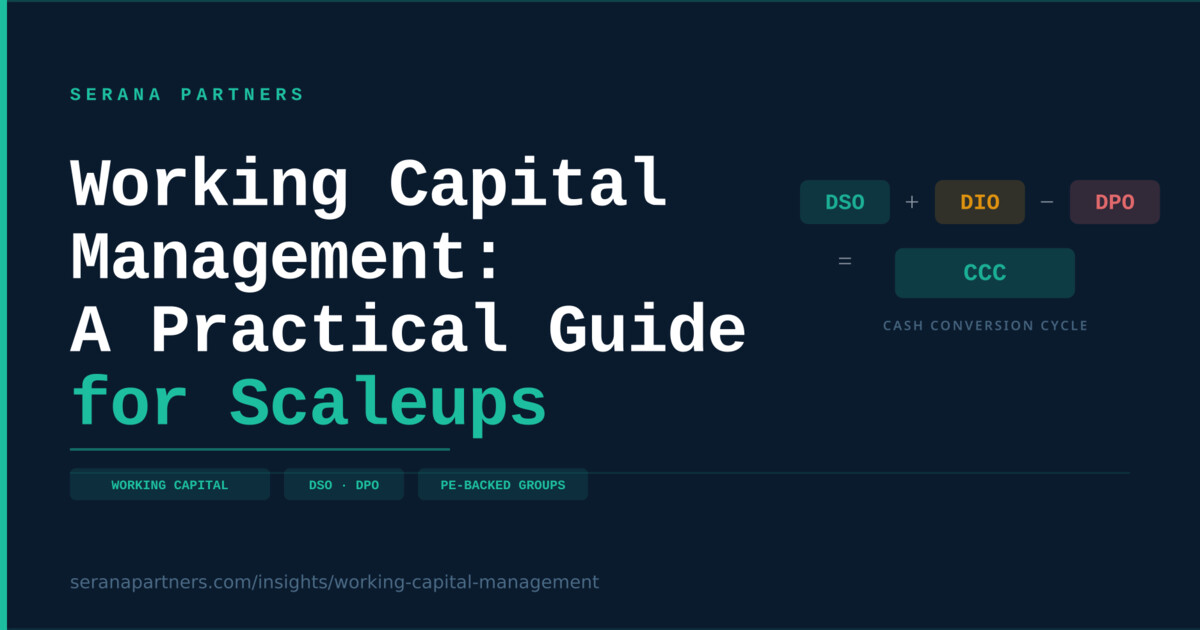
Cash Conversion Cycle = Days Sales Outstanding + Days Inventory Outstanding − Days Payables Outstanding
Or more practically: how long do customers take to pay you, plus how long does stock sit before it turns, minus how long you take to pay your suppliers.
A shorter CCC means cash comes back faster. A longer CCC means you are effectively financing your customers and your supply chain out of your own working capital — a cost that rarely appears explicitly on the P&L but shows up constantly in your cash position.
The Three Levers
Lever 1: Accounts Receivable — Getting Paid Faster
Most businesses invoice on 30-day terms. Most businesses get paid in 45 to 60 days. The gap between those two numbers is where cash disappears.
The reasons are familiar: invoices go to the wrong contact, get stuck in an approval process, get queried on a line item, or simply sit in a queue. None of this is malicious. Most of it is preventable.
What effective AR management looks like:
- Invoices raised the day goods are delivered or services are performed — not at month-end
- Invoices sent to the correct billing contact, with the correct PO number, in the format the customer's AP system requires
- A structured chasing sequence: a reminder at day 25, a first chase at day 32, an escalation at day 45, a senior escalation at day 60
- Ageing reports reviewed weekly, not monthly — problems compound when left for a month
- Dispute resolution as a fast-track process: a queried invoice that sits unresolved for three weeks is a cash flow problem masquerading as an admin issue
- Credit terms reviewed annually per customer — high-volume, low-risk customers may warrant extended terms; slow-paying customers warrant shorter ones
Lever 2: Accounts Payable — Paying Smarter
AP management is not about delaying payment to the point of damaging supplier relationships. It is about paying on the last day of agreed terms, not before, and negotiating terms that reflect the commercial reality of the relationship.
Most finance teams, under time pressure, run payment runs at convenient intervals rather than optimal ones. The result is suppliers being paid early (free cash given away) or late (relationship damage, credit risk, potential supply disruption).
What effective AP management looks like:
- Payment runs scheduled to align with terms — weekly runs for short-term suppliers, bi-weekly for standard 30-day terms
- Terms reviewed annually — a supplier you pay on 14 days who would accept 30 is giving you an interest-free loan you are not taking
- Early payment discounts evaluated on their actual annualised cost — a 2% discount for payment 20 days early equates to a 36% annualised rate. Take it if you have surplus cash; decline it if you don't
- AP ageing reviewed regularly to catch invoices approaching the end of terms before they become overdue
- Duplicate payment controls to prevent the same invoice being paid twice — more common than most teams admit, particularly post-acquisition
Lever 3: Inventory — Holding Less Without Running Out
For businesses with physical stock, inventory is frequently the largest and least-managed working capital component. Slow-moving SKUs tie up capital indefinitely. Safety stock levels set years ago may no longer reflect actual demand patterns. Seasonal stock built up before a peak period may not be drawn down as fast as forecast.
The discipline here is not dramatic — it is regular:
- ABC analysis of inventory by value and turn velocity
- Minimum and maximum stock level reviews against actual demand patterns
- Write-down of obsolete stock before it distorts the balance sheet
- Supplier lead-time negotiations that allow smaller, more frequent orders
For service businesses and SaaS companies, inventory management is typically not material. The AR and AP levers are where the work is.
The KPIs That Matter
Working capital management requires a small set of metrics tracked consistently. These are the ones that matter.
← scroll to see full table →
The Most Common Working Capital Mistakes
AR chasing is not admin. It is cash collection. It should be owned by someone with authority, tracked against targets, and escalated when it fails. Finance teams that treat chasing as a low-priority task will always have a working capital problem.
Paying every Friday regardless of when invoices are due means some suppliers get paid early every cycle. Early payment is free money given away.
Many businesses track invoice terms but not actual payment behaviour. These are different numbers. If your terms are 30 days and your customers pay in 52, your cash flow model should use 52 — not 30.
Revenue is recognised when a service is performed or goods are delivered. Cash arrives when the customer pays. The gap between those two events is your working capital exposure. Confusing the two leads to cash surprises.
A business growing at 40% per year is increasing its receivables balance at 40% per year. If DSO stays constant, the cash required to fund that receivables growth has to come from somewhere — profit, debt, or equity. This is why fast-growing companies can be profitable and cash-constrained simultaneously.
Working Capital and Cash Flow Forecasting
Working capital management and cash flow forecasting are not separate disciplines — they are two views of the same problem.
A 13-week cash flow forecast is where working capital assumptions get tested in practice. If your debtor days assumption is 35 but your customers are actually paying in 50, the forecast will be wrong from week three. Closing the loop between the forecast and actual collections is where working capital improvement starts — because you cannot improve what you have not measured.
The most effective working capital programmes combine three things: a live cash flow forecast updated weekly, an AR ageing report reviewed weekly, and a payment run process aligned to AP terms. Together, they give the finance team a complete view of cash in, cash out, and where the leaks are.
→ Read our guide: How to Build a 13-Week Cash Flow ForecastHow to Build a Working Capital Improvement Programme
Most businesses can improve their working capital position meaningfully within 90 days. The process is not complicated — it requires focus and consistent execution.
- Weeks 1–2
Diagnose
Pull AR and AP ageing. Calculate DSO, DPO and CCC. Compare actual debtor days to invoice terms for your top 20 customers by outstanding balance. Identify the three to five largest overdue balances.
- Weeks 3–4
Quick wins
Chase the three to five largest overdue balances directly. Review payment run timing and align to terms. Identify any suppliers being paid early and adjust to terms.
- Weeks 5–8
Process
Implement a structured AR chasing sequence. Set up weekly AR and AP ageing reviews. Review credit terms for the top ten customers by revenue. Identify any customers on 14-day terms who would accept 30.
- Weeks 9–12
Measure and integrate
Track DSO and DPO weekly. Build working capital KPIs into the monthly management accounts. Set a CCC target for the next quarter. Identify one or two further improvements to pursue in the next cycle.
Frequently Asked Questions
How Serana Partners Can Help
Working capital management is one of the most impactful things a finance team can focus on, and one of the most under-resourced in practice. Our managed team manages AR and AP day to day — chasing outstanding invoices, running payment cycles aligned to terms, producing weekly ageing reports, and tracking working capital KPIs as part of the monthly close.
Most working capital engagements start with a short diagnostic — one to two weeks to understand the current AR and AP position, identify the biggest cash leaks, and agree on a 90-day improvement plan.